
Despite rooftop installations crossing record numbers under the PM Surya Ghar Muft Bijli Yojana, widespread solar panel myths continue to circulate across India. Many homeowners and commercial property owners hold onto outdated beliefs from a decade ago when photovoltaic technology was less mature and significantly more expensive.
Believing these solar panel myths often leads consumers to miss out on dramatic electricity bill reductions, government financial incentives, and long-term energy independence. This comprehensive guide examines the seven most persistent solar panel myths in India and replaces them with verified performance data, current subsidy guidelines, and real-world engineering facts.
TABLE OF CONTENT
- Myth 1: Indian Summer Heat Destroys Solar Panel Efficiency
- Myth 2: Solar Systems Are Too Expensive for Average Households
- Myth 3: Panels Produce Zero Power During Monsoon and Cloudy Days
- Myth 4: Solar Setups Require Constant, High-Cost Maintenance
- Myth 5: Mounting Structures Damage Roof Integrity and Cause Leaks
- Myth 6: Solar is Useless at Night Without Expensive Battery Banks
- Myth 7: Government Solar Subsidies Are Fake or Never Actually Paid
- Solar Reality vs. Solar Myths
- Partner with Reliable Solar Solutions
- Frequently Asked Questions (FAQs)
Myth 1: Indian Summer Heat Destroys Solar Panel Efficiency
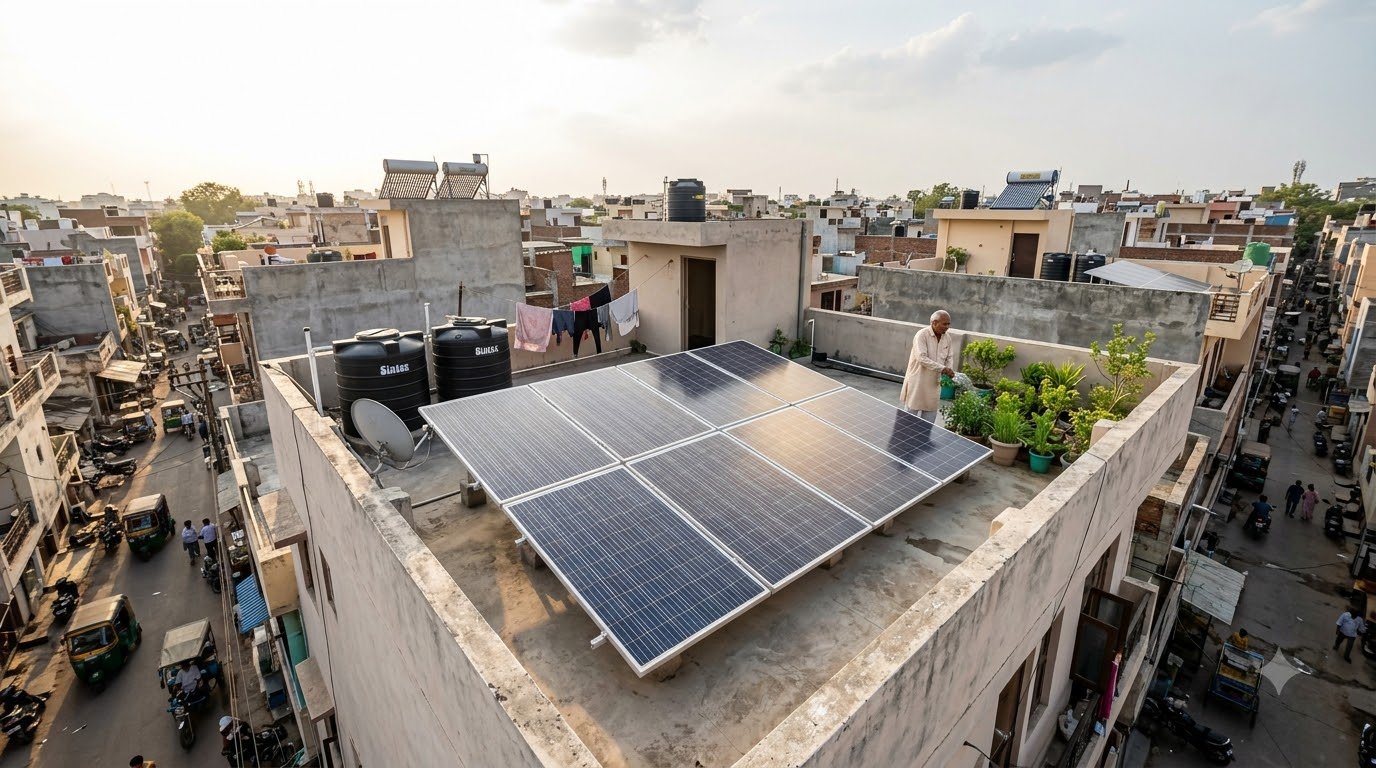
A widespread claim is that solar panels stop working or lose most of their output during India’s intense summer months. While it is true that crystalline-silicon modules possess a negative temperature coefficient losing roughly 0.3% to 0.5% of rated power for every degree Celsius above 25°C the overall impact on annual energy production is modest.
India’s high solar irradiation levels more than offset high ambient temperatures. Measured annual yields in sun-drenched states like Rajasthan, Gujarat, and Karnataka routinely reach 2,100 to 2,300 kWh per installed kilowatt, nearly double the yield recorded in cooler European climates. Furthermore, professional engineering teams design rooftop layouts with a mandatory ventilation clearance underneath the mounting structures, allowing natural air circulation to cool the modules and maintain high generation levels throughout peak summer.
Myth 2: Solar Systems Are Too Expensive for Average Households
One of the most financially damaging solar panel myths is that rooftop systems remain a luxury reserved only for wealthy property owners. In reality, global module production scale has driven hardware prices down by approximately 80% over the last decade. Coupled with aggressive government support, solar energy is now more accessible than ever.
Under the central government’s PM Surya Ghar scheme, eligible residential consumers receive up to ₹78,000 in Central Financial Assistance (CFA) for a 3 kW system. After accounting for this direct subsidy, it costs most families between ₹65,000 and ₹90,000. With current utility grid tariffs, typical payback periods range from three to five years. If you want to calculate your exact breakeven timeline, read our step-by-step guide on how to claim solar subsidies in Karnataka .
Myth 3: Panels Produce Zero Power During Monsoon and Cloudy Days
Many consumers believe solar panels shut down completely whenever storm clouds roll in. This doubt is particularly common in heavy-rainfall regions. However, solar cells do not rely exclusively on direct sunlight; they harvest energy from all visible light spectrums, including the diffuse radiation that penetrates cloud cover.
On heavily overcast or monsoon days, photovoltaic systems typically generate between 15% and 40% of their clear-sky capacity. Furthermore, heavy rain serves as a free, natural cleaning mechanism that washes away accumulated dust, industrial soot, and bird droppings from the module glass. To learn more about seasonal performance variations, read our article explaining the efficiency of solar panels in monsoon
Myth 4: Solar Setups Require Constant, High-Cost Maintenance
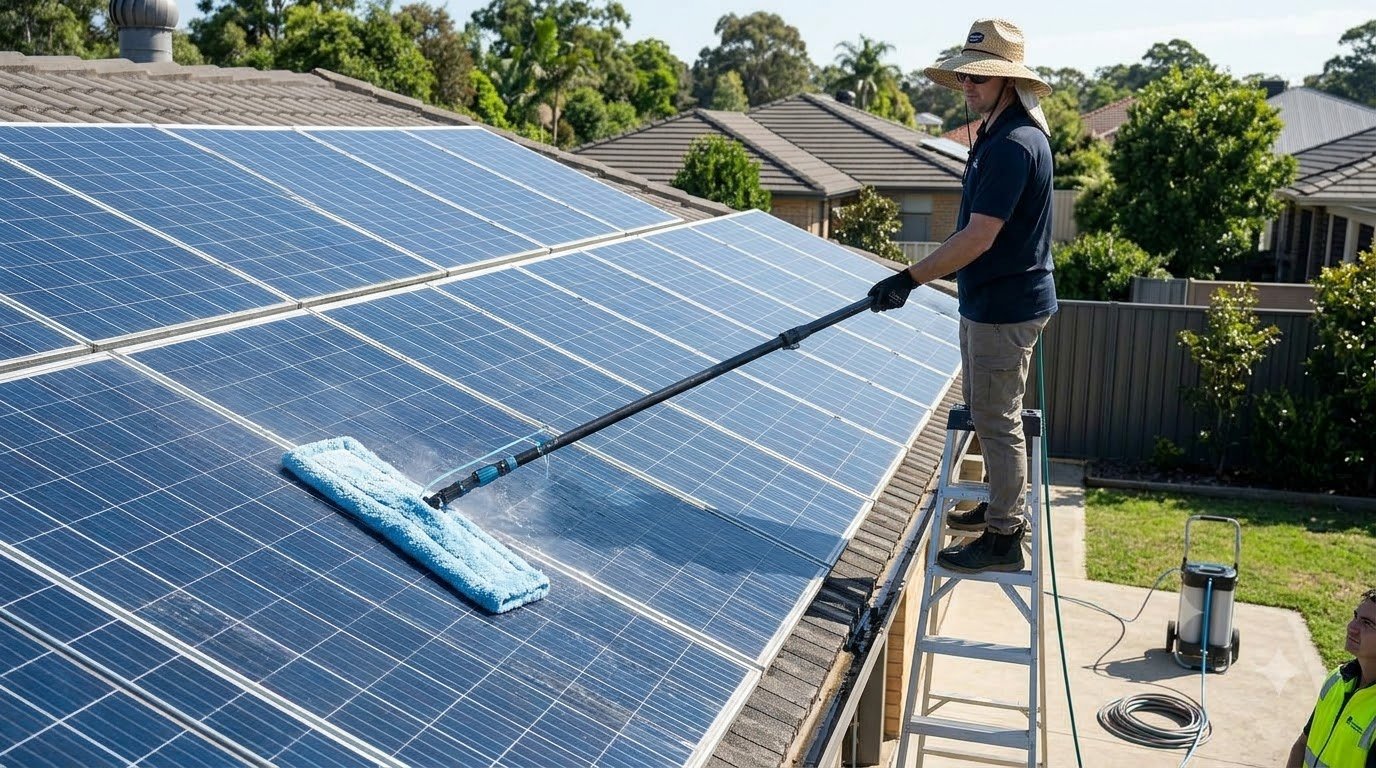
The fear of ongoing, complex mechanical upkeep deters many potential buyers, making this one of the easiest solar panel myths to dismantle. Solar photovoltaic systems are solid-state devices with zero moving mechanical parts, meaning there are no gears to lubricate, belts to snap, or engines to service.
Routine maintenance is straightforward: washing the glass surface with water every few weeks to remove dust buildup, along with an annual electrical safety check. Professional maintenance typically cost between ₹3,000 and ₹8,000 annually for residential setups. Given that Tier-1 manufacturers provide 25-year performance warranties, the long-term upkeep burden is negligible compared to conventional diesel power generators.
Myth 5: Mounting Structures Damage Roof Integrity and Cause Leaks
Property owners frequently worry that drilling mounting anchors into concrete slabs will cause structural weakening or water seepage during heavy rains. When installation is carried out by certified structural engineers, this risk is eliminated.
Qualified solar integrators follow Indian Standards for wind load resistance (IS 875) and use specialized chemical anchor fasteners paired with industrial waterproofing flashings. Rather than damaging your property, a high-quality solar array actually acts as a protective canopy, shielding the covered roof area from harsh UV radiation and direct downpours, which can extend the lifespan of your roof waterproofing membrane. To avoid installation hazards, review our guide on rooftop installation
Myth 6: Solar is Useless at Night Without Expensive Battery Banks
A persistent narrative suggests that solar energy provides no value after sunset unless you invest heavily in complex battery storage banks. While it is essential for properties subject to frequent grid blackouts, it is not mandatory for every standard rooftop user.
On-grid installations leverage bi-directional net metering. During daylight hours, your system supplies your home’s immediate electrical loads and automatically exports excess power to the main grid. At night, you draw power back from the grid, using your daytime credits to offset nighttime consumption. To understand grid export rules, read our complete guide to choose the right system for your home .
For commercial properties or remote facilities that demand uninterrupted 24/7 uptime, combining solar with storage via reliable power backup offers complete protection against utility outages.
Myth 7: Government Solar Subsidies Are Fake or Never Actually Paid
Skepticism surrounding government financial incentives remains widespread across India. Many buyers assume that subsidy promises under national schemes are bogged down in bureaucratic red tape and never reach the applicant’s bank account.
Official records on the government’s PM Surya Ghar National Portal show that millions of Indian families have successfully received their subsidy payouts via Direct Benefit Transfer (DBT). The process is managed through a single digital platform. By partnering with an officially empanelled vendor, submitting the online application correctly, and completing the mandatory net-metering inspection, subsidy funds are typically transferred directly to the consumer’s bank account within 30 to 45 days of commissioning.
Solar Reality vs. Solar Myths
Topic / Concern | The Common Solar Panel Myth | The 2026 Technological Reality |
Heat Impact | Extreme heat destroys output entirely. | Irradiation offsets heat loss; ventilation keeps yields high. |
System Cost | Only affordable for high-income buyers. | Subsidy covers up to ₹78,000; payback achieved in 3–5 years. |
Cloudy Performance | Systems stop generating power in rain. | Panels generate 15%–40% capacity using diffuse light. |
Maintenance | Requires frequent, expensive servicing. | Solid-state design needs only periodic water cleaning. |
Roof Safety | Causes leaks and damages concrete. | Engineered fasteners & sealants protect and shield roofs. |
Nighttime Use | Requires batteries or it is useless. | Net metering exports daytime power and offsets night usage. |
Government CFA | Subsidies are rarely paid out. | Digital DBT transfers credit funds directly in 30–45 days. |
Partner with Reliable Solar Solutions
Dispelling these persistent solar panel myths reveals that solar energy is one of the most reliable, cost-effective, and low-maintenance investments available today. However, realizing these benefits requires proper system design, quality components, and professional execution.
At Mahati Enterprises, we provide complete, turnkey renewable energy services tailored for residential, commercial, and industrial clients:
- Residential Solar Panel Installation : Custom rooftop solar setups designed to maximize PM Surya Ghar subsidy benefits.
- Commercial & Industrial Solar Solutions : High-capacity arrays engineered to reduce operational overhead for businesses.
- Hybrid Solar Systems & Solar Battery Storage : Advanced battery backups that ensure continuous power during grid outages.
- Off-Grid Solar Systems : Independent solar solutions for remote agricultural or commercial sites.
- Solar Panel Maintenance & Repairs : Annual AMC contracts, panel cleaning, and system health audits.
If you are ready to evaluate a backup energy system, explore our detailed articles that will surely be of help for a myth-free, customized site audit.